
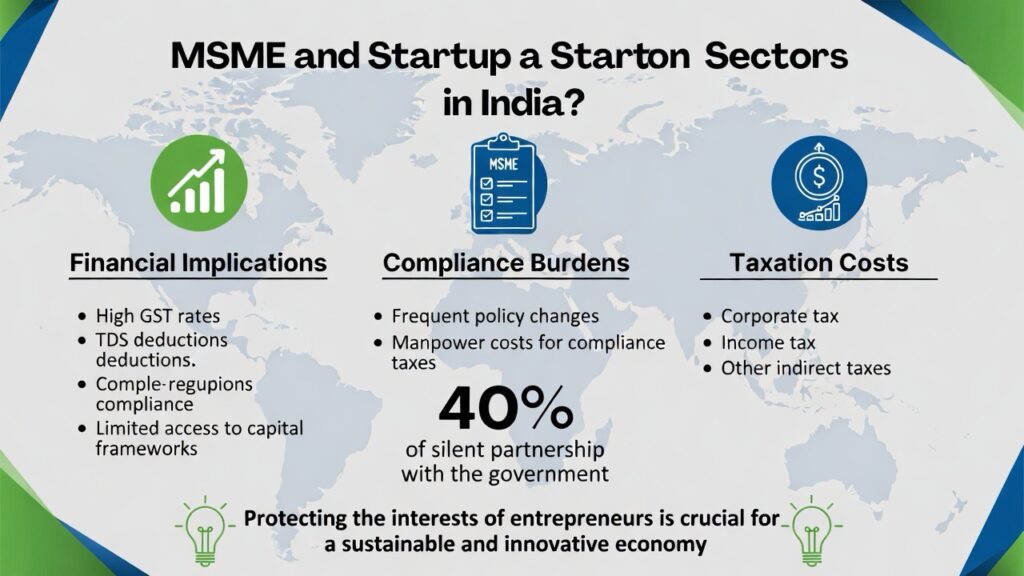
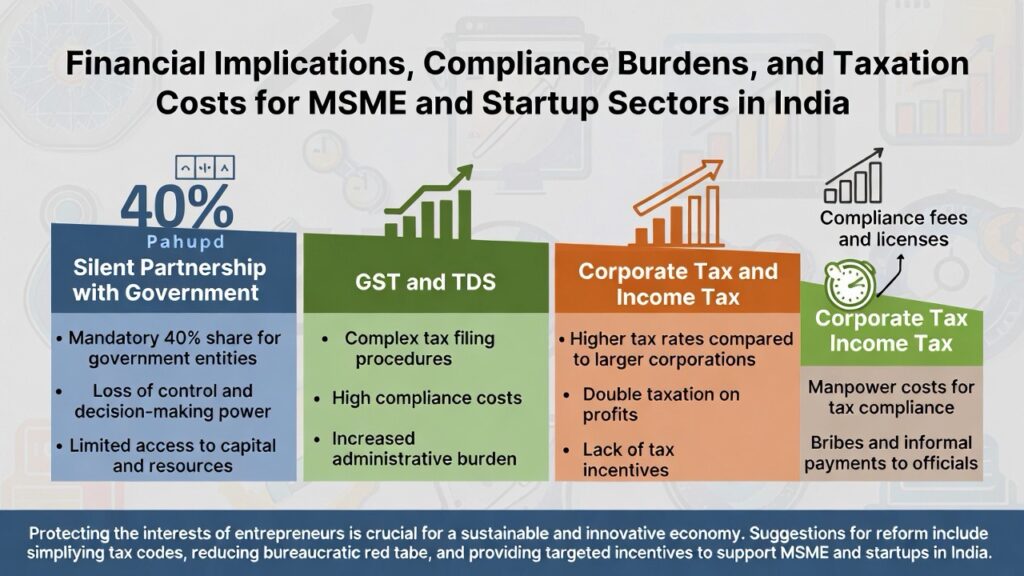
In the vibrant yet challenging landscape of India’s MSME and startup sectors—which power 30% of GDP, employ over 110 million people, and drive 45% of exports—entrepreneurs often pour their blood, sweat, and savings into innovative ideas. But beneath the success stories lies a harsh reality: an effective “silent partnership” with the government that can siphon off up to 40% (or more) of revenues through layered taxes, compliance burdens, and hidden informal costs. This isn’t hyperbole—it’s the aggregate impact of GST at an average 18%, TDS deductions up to 10%, corporate taxes at 25%, income taxes climbing to 30%, plus the unseen toll of regulatory filings, professional fees, and yes, the pervasive issue of bribes for licenses and approvals. As of 2026, with Union Budget tweaks offering some relief (like potential quarterly GST filings for micro-enterprises), the pressure remains immense, stifling innovation and sustainability.
This awareness post dives deep into these implications—from financial drain to psychological toll—drawing on real data from 2025-26 reports. We’ll explore nuances across sectors (manufacturing vs. services), edge cases (e.g., bootstrapped solopreneurs vs. VC-backed startups), and broader economic ripple effects. Most importantly, we’ll arm you with actionable strategies to safeguard your hard-earned venture, fostering a more resilient entrepreneurial economy.
1. The Tax Labyrinth: Layered Levies Eating into Profits
India’s tax regime, while simplified post-GST (now in its 8th year), creates a compounding burden. Here’s a breakdown based on FY 2025-26 (AY 2026-27) rates, tailored to MSMEs (turnover < ₹250 crore) and startups (recognized under DPIIT):
• GST (Goods & Services Tax): The average effective rate hovers at 11.8% overall, but for service-heavy MSMEs/startups, it’s often 18% on outputs minus inputs (with ITC credits). Under the Composition Scheme (for turnover < ₹1.5 crore), it’s a flat 1% for manufacturers or 5% for traders/services— a boon for micro-units but limiting ITC claims, which can inflate costs by 10-15% for growing firms. Nuance: E-commerce startups face reverse charge GST (5-18%), adding cash flow strain.
• TDS (Tax Deducted at Source): 1-10% on payments like salaries (10%), professional fees (10%), or interest (10% under Sec 194A, threshold ₹40,000). For a ₹10 lakh freelance contract, that’s ₹1 lakh locked in refunds—delayed by 6-12 months.
• Corporate Tax: 25% base for domestic MSMEs with turnover ≤ ₹400 crore (plus 4% cess; effective ~26%). Startups can opt for 15% (new manufacturing under Sec 115BAB) or 22% (Sec 115BAA, forgoing exemptions). Edge case: Angel-funded startups lose these if they scale beyond thresholds prematurely.
• Income Tax (for Proprietors/Individuals): New regime slabs: 0% up to ₹4 lakh, 5% (₹4-8L), 10% (₹8-12L), up to 30% (>₹24L) + 4% cess. Salaried founders in services often hit 20-30% brackets early.
Aggregate Impact: For a service startup with ₹50 lakh revenue (80% margin post-costs), expect ₹8-12 lakh in direct taxes (16-24%), plus GST outflows netting ₹4-6 lakh (8-12%)—totaling 24-36%. Factor in surcharges for high earners, and it edges toward 40%. Implication: Reduced reinvestment in R&D (startups spend 10-15% here), slower hiring, and vulnerability to cash crunches—exacerbated in inflation-hit 2026 (projected 5-6% CPI).
Sector Nuances: Manufacturing MSMEs benefit from 15% tax but face higher input GST (12-18%). Tech startups leverage SEZ exemptions but grapple with TDS on IP royalties (10%).
2. Compliance Overload: Time, Money, and Manpower Drain
Beyond taxes, compliance is a silent killer. MSMEs navigate 1,450+ regulations annually across 50+ laws (labor, environment, etc.), costing ₹13-17 lakh/year per unit—equivalent to 5-10% of turnover for micro-firms. This includes:
• Direct Costs: CA fees (₹50,000-2 lakh/year for filings), software (₹20,000+ for GST portals), and audits (mandatory for turnover >₹2 crore).
• Indirect Costs: 200-300 man-hours/year per founder on paperwork—diverting from core ops. A 2025 survey pegged this at 15-20% lost productivity.
• Edge Cases: Solopreneurs waste 40+ hours/month on monthly GST returns; bootstrapped startups skip filings, risking ₹10,000-5 lakh penalties.
Implications: High churn—30% of MSMEs fail in Year 1 due to “regulatory fatigue.” Broader economy: Stunted job creation (MSMEs add 8 lakh jobs/year but could double sans burdens) and innovation lag (startups file 20% fewer patents due to resource diversion).
3. The Shadow Economy: Bribes, Cash Conversions, and Informal Tolls
The elephant in the room: Corruption. A 2024-25 LocalCircles survey (echoed in 2026 updates) found 66% of businesses paid bribes in the past year—72% in services like licensing and permits. Breakdown:
• Licensing Bribes: 54% coerced for approvals (e.g., shop acts, environmental nods)—averaging ₹5,000-50,000 per instance, per informal sector data. Startups report 20-30% delays from “middlemen.”
• Cash & Banking Fees: Bribe cash (5-10% of transaction value) incurs 18% GST on conversion + 1-2% bank charges. A ₹1 lakh “facilitation” fee? Add ₹20,000 in indirect costs.
Nuances & Implications: Rural MSMEs pay 2x urban rates due to uneven enforcement; women-led startups face 15% higher “protection” demands. Psychologically, it erodes trust—40% of entrepreneurs report burnout. Economically, it distorts competition (ethical firms lose 10-15% market share) and fuels black money (₹20 lakh crore annually, per estimates).
4. Broader Ramifications: From Stagnant Growth to National Drag
These costs compound: A 2026 ASSOCHAM report flags compliance as the #1 manufacturing hurdle, ahead of capital access. Implications include:
• Financial: 25% lower profitability vs. global peers (India’s MSME ROI: 8-10% vs. 15% in ASEAN).
• Innovation: Startups allocate 20% less to tech (e.g., AI adoption lags by 2 years).
• Sustainability: 40% MSMEs under-report to evade costs, risking shutdowns during audits.
• Macro: Lost GDP potential—₹5-7 lakh crore annually if burdens halved. Edge case: Post-2026 global slowdown, export-oriented MSMEs (textiles, IT) could see 15% closures.
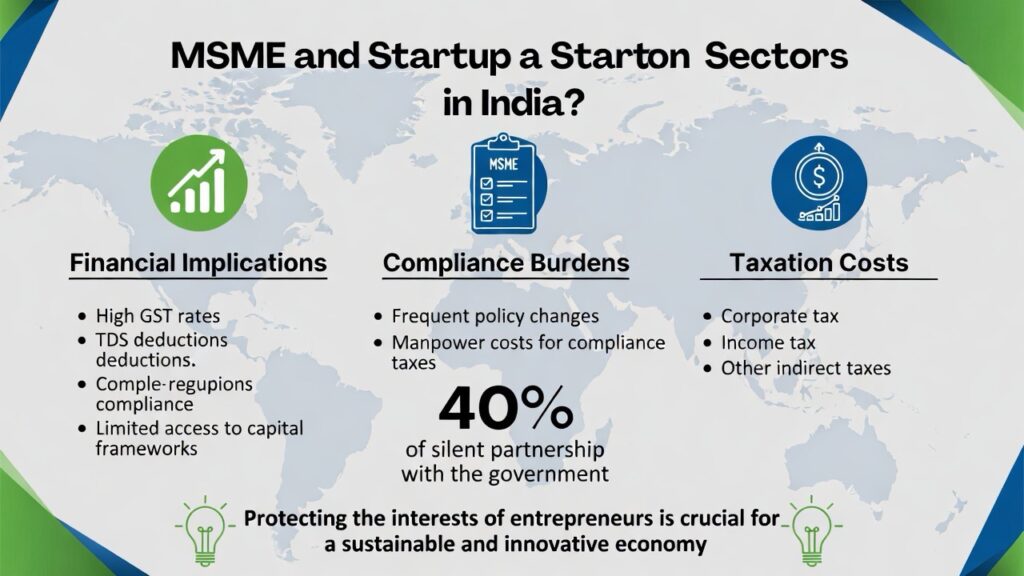
5. Empowering Entrepreneurs: Strategies to Shield Your Venture
You can’t eliminate the system, but you can outsmart it. Here’s a multi-angle playbook for 2026, blending government levers, tech, and advocacy:
Tax Optimization Tactics
• Leverage Schemes: Enroll in Startup India for 3-year income tax holiday (100% exemption on profits) and 80IAC deductions (accelerated depreciation). MSMEs: Use Composition Scheme to cap GST at 5%; claim 50% input credit via Invoice Matching.
• Entity Choice: Opt for Pvt Ltd under Sec 115BAA (22% tax) if scaling; sole prop for low-turnover (<₹20L) to avoid corporate tax.
• Refunds & Credits: File TDS quarterly; use AI tools like ClearTax for 90% faster GST ITC claims—saving ₹50,000/year.
Compliance Streamlining
• Digital-First: Adopt Udyam portal for single MSME registration (covers 20+ filings); integrate Tally/QuickBooks for auto-GST (reduces hours by 70%).
• Outsource Smartly: Hire shared CAs (₹20,000/quarter) via platforms like Vakilsearch; join co-working hubs with bundled compliance (e.g., WeWork’s MSME packs).
• Edge Case Prep: For bootstrappers, use free DPIIT tools; VC-backed? Negotiate compliance clauses in term sheets.
Combating Hidden Costs
• Anti-Bribe Shields: Document everything digitally; use GEM portal for transparent govt tenders (zero bribes reported in 80% cases). Report via CVC app—anonymous, with whistleblower protection.
• Cash Alternatives: Go digital with UPI/Razorpay (1% fees vs. 18% GST on cash conversions); seek NBFC loans (9-12% interest) over bribe-fueled shortcuts.
• Community Power: Join FICCI-MSME forums for collective advocacy—pushing 2026 reforms like single-window clearances.
Funding & Growth Boosters
• Schemes Galore: PMEGP (35% subsidy on projects <₹25L); SISFS (₹50L seed fund, no equity dilution). CGTMSE for collateral-free credit (up to ₹2 crore at 0.37% fee).
• Sustainability Angle: Adopt green practices for 25% tax rebates under Sec 32AD; export via ECGC insurance (reduces risk by 90%).
Pro Tip: Track via a “Cost Dashboard” (Excel/Google Sheets)—monthly audit taxes vs. revenue. Aim for <25% effective burden through iterative tweaks.
Call to Action: Build a Sustainable Entrepreneurial India
The 40% silent tax isn’t inevitable—it’s a call for reform. Entrepreneurs, audit your books today; policymakers, heed the 73 million MSME voices. By optimizing, advocating, and innovating around these hurdles, we can unlock a trillion-dollar startup economy. Share your story below: What’s your biggest cost battle? Let’s collaborate for change.
#MSMEIndia #StartupIndia #TaxReform #EntrepreneurLife #SustainableBusiness
(Sources: Income Tax Dept, PwC, LocalCircles, ASSOCHAM, NITI Aayog—full links in comments. Consult a CA for personalized advice.)